


Are you considering calculating your company’s carbon footprint? It can feel complex and time-consuming, but it doesn't have to be.
In this guide, we draw on our own experience to walk you through your first carbon footprint calculation. We’ll show you how spend‑management tools like Pleo help you capture a fuller picture of your emissions, and how you can apply the same steps in your business.
What is carbon accounting?
Carbon accounting is a bit like financial reporting… just with a greener lens. It’s the process of measuring a company’s greenhouse gas (GHG) emissions to understand its climate impact. Just like tracking spend reveals where your budget's going, carbon accounting shows which parts of your operations carry the biggest environmental weight.
The goal is to get a complete, accurate, and reliable picture of your emissions so you can make better decisions.
The tricky bit tends to be data. Collecting it, cleaning it, chasing it down. It’s time-consuming, especially for lean teams who want to scale fast. That’s why many businesses start with what they already have: spend data. If you’re wondering whether Pleo can help here… the short answer is yes.
Here’s a practical, step-by-step guide inspired by how we used our own spend data to build a picture of our emissions, and how we’ve since improved our approach to get a clearer, more accurate view.
Your step-by-step guide to carbon accounting
Step 1: Map your goals and your stakeholders
Before you collect any data, you need to know exactly what you'll use it for. Getting clear on your goal upfront will determine which emissions you track, how granular you need to go, and how future-proof your setup will be. At Pleo, our goal was to build a carbon accounting model that’s solid enough to scale, nimble enough to adapt, and reliable enough to inform how we operate and how we communicate our impact.
Once you’ve defined your goal, the next step is to map your data sources and the people behind them. The information you’ll need is unlikely to sit neatly in one place, and it rarely comes with a label. So as a fintech business, our process was very cross-functional. Here’s how we approached it with each team:
- Workplace provided energy usage across our offices
- Finance surfaced spend data directly from Pleo
- Payments, Partnerships & Ops helped us quantify the impact of our physical cards
- Data & Engineering pulled usage data from key cloud providers, which we translated into emissions
Every function held a different piece of the puzzle. By pulling them together early, we built a clearer picture (and a more useful one) from the get-go.
Tip: Build a core project team
Start by creating a small project team with a clear brief and explaining the objective: why it matters, what it supports, and what’s expected. Early buy-in makes a big difference, especially when it comes to data collection and ongoing updates. Then get specific. Map out key stakeholders and document who holds which data, from energy bills to cloud usage to card production. Treat this as your internal data blueprint. It’s one of those small but important initial efforts that saves time, questions, and email chains later on.
Step 2: Define your boundaries
Once you have your team, you need to define your organisational and operational boundaries.
An organisational boundary defines what parts of your company are in scope for accounting. Think subsidiaries, offices, entities. Essentially, the parts of the business you want reflected in your carbon footprint. Your legal and operational structure will help guide this, as will the way you plan to report and analyse your data.
Next, set your operational boundaries. This is where you define the emissions you’ll track, both direct and indirect. For example, will you include emissions from energy consumption, business travel, and waste?
At Pleo, we covered the offices under our direct operational control and considered Scope 1, 2, and 3 emissions following the Greenhouse Gas Protocol (GHGP):
- Scope 1: Direct emissions from sources we own or control, like fugitive emissions from air conditioning systems.
- Scope 2: Indirect emissions from purchased energy, like electricity for the offices.
- Scope 3: Broader indirect emissions across our value chain, like purchased goods and services. From the 15 categories defined by the GHGP, we focused on the 6 applicable to Pleo's operations.
Tip: Keep it realistic
Go through each of the emission scopes (1, 2, and 3) with your stakeholders and prioritise what’s relevant and possible for your business today. Start with what reflects your operations and goals best, not everything you could track. This makes for a foundation that’s accurate, manageable, and ready to grow.
Step 3: Use Pleo data to get a head start
This is where having a spend management tool like Pleo gives you a real advantage. Because every purchase runs through the app, automatically processed, categorised and tagged, you already have a rich dataset that can be used to estimate emissions.
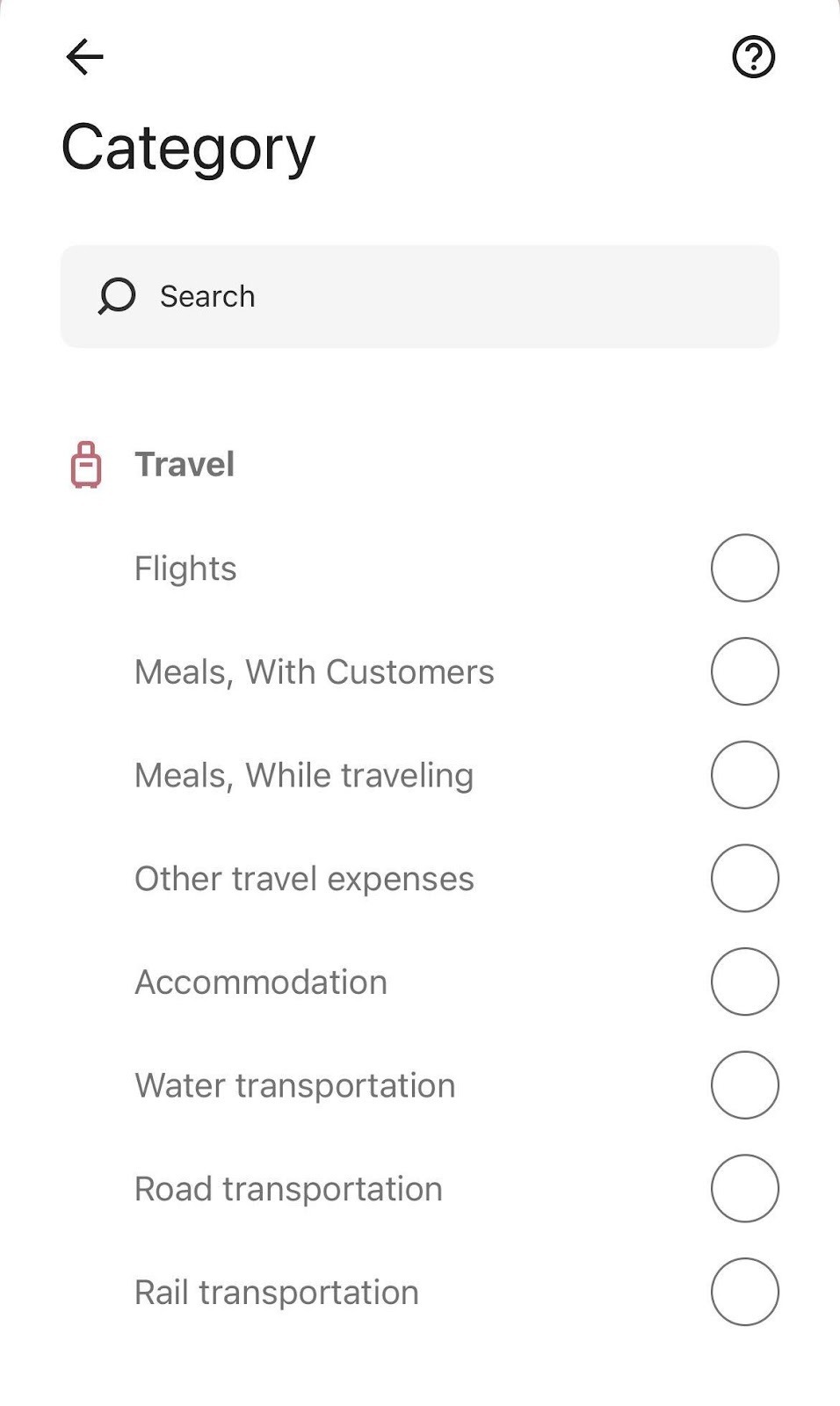
Here’s what we learned: for a business like ours, travel is a big category for emissions (862 tonnes CO₂e). But the first time we measured it, our data didn’t tell us much. We’d lumped most travel expenses into a single “Other Transportation” category. That gave us volume, but not insight.
To fix this, we refined our setup. Instead of one generic category, we introduced more specific ones:
- Road transportation
- Rail transportation
- Water transportation
Combined with our existing “Flights” category, this gave us far more granularity without adding friction for employees submitting expenses. And it’s all done through the app!
Tip: Let your Pleo categories do the heavy lifting
Use the steps above, and audit your category setup. If travel is a key emissions driver, create more specific sub-categories that match how your team moves. That way, when it’s time to apply emission factors, you’ll be working with cleaner, more detailed data.
Not sure where to start? Your Customer Success Manager can walk you through the optimal category design, or raise a support ticket and we’ll help get you sorted.
Step 4: Use a carbon accounting tool
Once you have your data, it's time to handle the actual accounting. At Pleo, we partnered with Persefoni, a platform built for audit-grade carbon accounting with robust analytics and clear reporting outputs. It aligns with the level of rigour we need as we scale and anticipate future regulations.
For our business travel, we simply exported our categorised data from Pleo and uploaded it to Persefoni. The tool then handled the calculations, giving us a clear estimate of our carbon emissions.
Tip: Match the tool to your maturity
Choose a platform that fits your current needs and growth plans. Many businesses can get started with a free self-service tool. Persefoni’s free plan, for instance, is a solid option for early-stage efforts.
The goal is to start building a footprint you trust without overcommitting budget or time from day one.
Step 5: Turn results into actionable insights
So, you've done the work and have results in hand. But arriving at results is just the start – and this is where many sustainability efforts stall. A carbon footprint, however accurate, is only useful if people across the business understand what it means and why it matters.
As part of our own journey at Pleo, we learned early on that visibility is key. We share our reports internally, highlighting key insights and 'Aha!' moments for everyone across the business. This helps make our carbon footprint feel less abstract and ties it to everyone's everyday actions, from travelling to choosing vendors.
The aim isn’t to overwhelm people with data. It’s to make the information relatable, so it becomes part of how decisions are made.
Here are some of the key findings from our latest carbon accounting cycle:
- 99% of our emissions are Scope 3 – indirect emissions from our value chain
- 78% of those Scope 3 emissions come from Purchased Goods and Services
- Flights account for 86% of our business travel emissions
These numbers help us ask better questions and spark the right conversations: Where can we shift supplier choices? Can we travel less, or travel smarter?
Tip: Bring your findings into the room
This is your chance to take your insights to the wider team and leadership. Use your report to come up with an action plan, agree on new goals, and start building a more climate-focused culture in your business.
Step 6: Share the journey
Once you’ve set goals and have actions in place to reduce your impact, it’s time to share your journey with the wider community. Did you know that over a third of consumers are willing to pay more for sustainability? Making your sustainability efforts visible to your prospects and customers is key, as some will even use it as a deciding factor¹.
At Pleo, we’re currently developing our first external Sustainability Report, planned for release in 2026. It will reflect the progress we’ve made, the challenges we’ve faced, and the priorities guiding us forward. Our goal is to create a report that’s not only transparent and accountable, but genuinely useful – to our customers, our partners, and to others navigating similar journeys.
We consider sustainability to be a long-term commitment, rooted in relevance, grounded in data, and aligned with how we want to grow as a business.
If you're just starting out, we hope this guide gives you not just confidence but a practical starting point. Every step counts, and how you document and share those steps can shape your culture, influence your stakeholders, and strengthen your position in the market.