



Even the most experienced finance leaders hit moments where decisions feel heavier, slower and harder to make. This isn’t a lack of skill or insight – it’s decision-freeze: a state where uncertainty, complexity or conflicting signals stall action. Leaders know they need to act, but somehow, the right move never feels clear enough to commit.
Decision-freeze is becoming increasingly common in finance and leadership. Markets are more volatile, risks are harder to quantify and organisations operate in a landscape where a single misstep can have outsized consequences. At the same time, teams are managing more data, more systems and more voices than ever before. The combination of high stakes and high complexity creates the perfect environment for hesitation to take hold.
Understanding why decision-freeze happens, what it costs and how to break out of it is critical. Finance leaders who can navigate these moments with clarity and confidence turn uncertainty into an advantage, making faster, smarter decisions that keep the business moving forwards.
Key takeaways:
- Decision-freeze is normal – but it’s costly. High uncertainty, complex data, multiple tools and competing voices can stall even the most experienced finance leaders.
- The hidden costs ripple across the business. Hesitation impacts opportunities, team confidence and the accuracy of forecasting, budgeting and cash flow management.
- When it comes to regaining momentum, clarity and ownership are critical. Simplifying tools and clearly defining decision responsibilities helps teams act faster and more decisively.
- Using data wisely, encouraging experimentation and building decision confidence turns hesitation into action and restores organisational agility. The freeze can be broken – it’s just about creating a system and a culture that allow decisions to be made confidently.
Why does decision-freeze happen?
Decision-freeze isn’t caused by a lack of skill or experience; it’s the environment finance teams find themselves operating in today. The pace of business is faster, the data landscape more crowded and the stakes higher than ever.
When uncertainty is high and risks are amplified, even routine decisions can start to feel overwhelming. Add multiple tools, countless dashboards and a chorus of voices weighing in, and it’s easy to see why hesitation can take hold. Understanding the main drivers behind decision-freeze is the first step in cutting through the noise and regaining momentum.
Information overload
Finance leaders are drowning in data. Every system, every dashboard, every report – they all promise ‘insights’, but more information doesn’t always mean more clarity.
When you’re juggling macroeconomic signals, internal KPIs, forecasting models and board expectations, it’s easy to lose sight of what actually matters. Too much information can paralyse momentum, making even straightforward decisions feel like high-stakes guesswork.
Too many tools
Modern finance leaders can hardly move for tools designed to make their lives easier – but ironically, those very tools can end up slowing everything down. ERP here, spend tool there, invoice automation somewhere in between; finance stacks have exploded, and that brings a new set of challenges.
Data gets siloed, workflows get messy and leaders end up trusting spreadsheets more than the tech they paid for. The numbers speak for themselves:
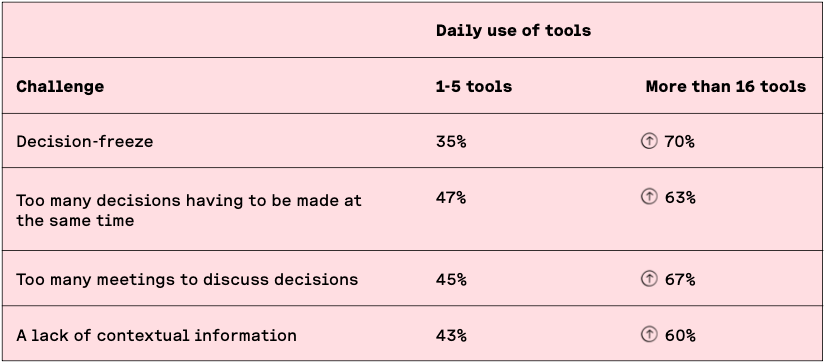
Source: The power of better business decisions
When systems don’t speak the same language, decision-making becomes a frustrating game of ‘find the source of truth.'
Risk aversion
Uncertain markets naturally make leaders more cautious. But when caution turns into hesitation, teams stall. CFOs feel the pressure to be right, not just fast – and with constant volatility, it can feel safer to wait for ‘one more data point’ before committing.
Over time, that mindset can calcify into a general reluctance to act, even when opportunities are right in front of you.
Too many voices
Modern finance is more cross-functional than ever. It’s great for alignment, but not so great for decisiveness. With input coming from product, sales, operations, HR and the board, the decision-making process can feel like trying to land a plane with five copilots.
Everyone has a view, and synthesising them takes time. When every stakeholder needs to sign off, decisions can grind to a halt.
Decision-freeze isn’t a personal failing; it’s a natural reaction to a noisy, fast-shifting environment. However, whilst the causes are often subtle, the impact is rarely so. When decisions slow down, the ripple effects can spread quietly across the business.
And that’s where the real challenge lies. Decision-freeze carries hidden costs that affect everything from team morale to financial performance. Before long, what started as a pause can turn into a pattern.
So – what does that look like in practice?
The hidden costs of decision-freeze
Decision-freeze isn’t always obvious – and that’s part of what makes it so costly. Whilst leaders wait for the ‘perfect moment’ or the ‘final data point,’ the business keeps moving… just not always in the right direction. Opportunities slip away – whether it’s a new customer segment, a cost-saving contract or a chance to move ahead of competitors. In fast-moving markets, hesitation can quickly become expensive. And the effects don’t stop there.
Teams look to finance leaders for clarity, especially when the landscape gets uncertain. When decisions stall, people start filling in the gaps themselves – often with worry. Momentum fades, confidence dips and hesitation at the top can ripple through the organisation, creating a culture of caution.
Financial operations also feel the strain. A single delayed decision – on an investment, a budget adjustment or a strategic shift – can cascade across forecasting, budgeting and cash flow management. What seemed like a small pause at the top can create weeks of catch-up downstream, keeping finance teams constantly recalibrating.
Over time, these delays quietly erode business agility. Opportunities require more discussion, risks take longer to assess and projects get stuck in limbo. A cost no business can afford to ignore.
Recognising the hidden costs is the first step. Understanding the ripple effects – missed opportunities, shaken confidence, the slow drain on agility – makes it clear that staying frozen isn’t an option.
The good news? Decision-freeze isn’t permanent.
Breaking the freeze: How leaders can regain momentum
With small, deliberate steps that cut through the noise and restore clarity, leaders can regain momentum. From simplifying the tech stack to clarifying who owns which decisions, there are several practical strategies that help teams move forward with confidence.
Using data the right way, encouraging experimentation and building decision confidence can all turn hesitation into action – without compromising careful judgment. Here’s how finance leaders can cut through the noise and regain momentum:
1. Simplify the tech stack
Fewer tools – or at least fewer disconnected tools – means less time hunting for information and more time making actionable decisions. When systems communicate effectively, finance teams spend less time reconciling data and more time leading. Simplifying the stack creates clarity and reduces the cognitive load that often triggers freeze.
2. Clarify decision ownership
When everyone knows who is responsible for what, decisions happen faster and accountability becomes clear. Teams stop waiting for consensus on every detail, and leaders can focus on the decisions that truly matter. Clear ownership ensures action doesn’t get stuck in endless discussion.
3. Use data to empower, not overwhelm
Data is a double-edged sword. The key is presenting the most relevant insights in a way that guides decision-making rather than drowning teams in dashboards. Focus on quality over quantity – the right metrics, at the right time, to inform confident decisions.
4. Encourage ‘informed experimentation’
Not every choice needs to be permanent. Small tests and iterative approaches allow leaders to act without fear of irreversible mistakes. When teams see experiments as safe and instructive, hesitation gives way to curiosity and initiative, and momentum returns.
5. Build decision confidence
Confidence is contagious. Celebrate decisive actions, learn from missteps and create a culture where timely, well-informed decisions are valued over endless deliberation. Confidence breeds speed, and speed restores agility.
Breaking decision-freeze by creating clarity, confidence and a culture that supports action is key. By simplifying tools, clarifying ownership, using data wisely, encouraging experimentation and building decision confidence, leaders can move from hesitation to confidence.
When these strategies are in place, finance teams regain their agility, make faster, more informed decisions and guide the business forward – even when uncertainty is high.
Turning hesitation into action
Decision-freeze may feel inevitable in a fast-moving, uncertain world – but it doesn’t have to define how finance leaders operate. Awareness is the first step: recognising the triggers, understanding the hidden costs and seeing how hesitation ripples across the business.
From there, regaining momentum comes down to practical, deliberate action. Simplifying processes, clarifying ownership, using data wisely, embracing experimentation and building decision confidence aren’t just nice-to-haves – they’re essential tools for steering the business forward with clarity and agility.
Ultimately, uncertainty will always be part of running a business. But, it’s about creating an infrastructure and environment that allow decisions to be made confidently – even when the path ahead isn’t completely clear. For finance leaders, that means turning hesitation into action, restoring momentum and ensuring that the organisation can seize opportunities rather than letting them slip by.
Because in today’s fast-paced business landscape, agility isn’t optional: it’s a competitive advantage.