



Welcome to the inaugural European Finance Index* — a quarterly read on where business spending across Europe is actually moving.
No dense whitepapers. No 50-page reports. Just a clear view of what companies are prioritising, where they're pulling back, and what they're watching as the next quarter approaches.
In this edition, we’re taking a look at the critical shifts in the UK’s 26Q1 spending data, particularly regarding Generative AI and, yes, the caffeine economy.
*The insights in this blog post are based on aggregated and anonymised spending data of over 40,000 customers across Europe.
Budget allocation: Europe vs the United Kingdom
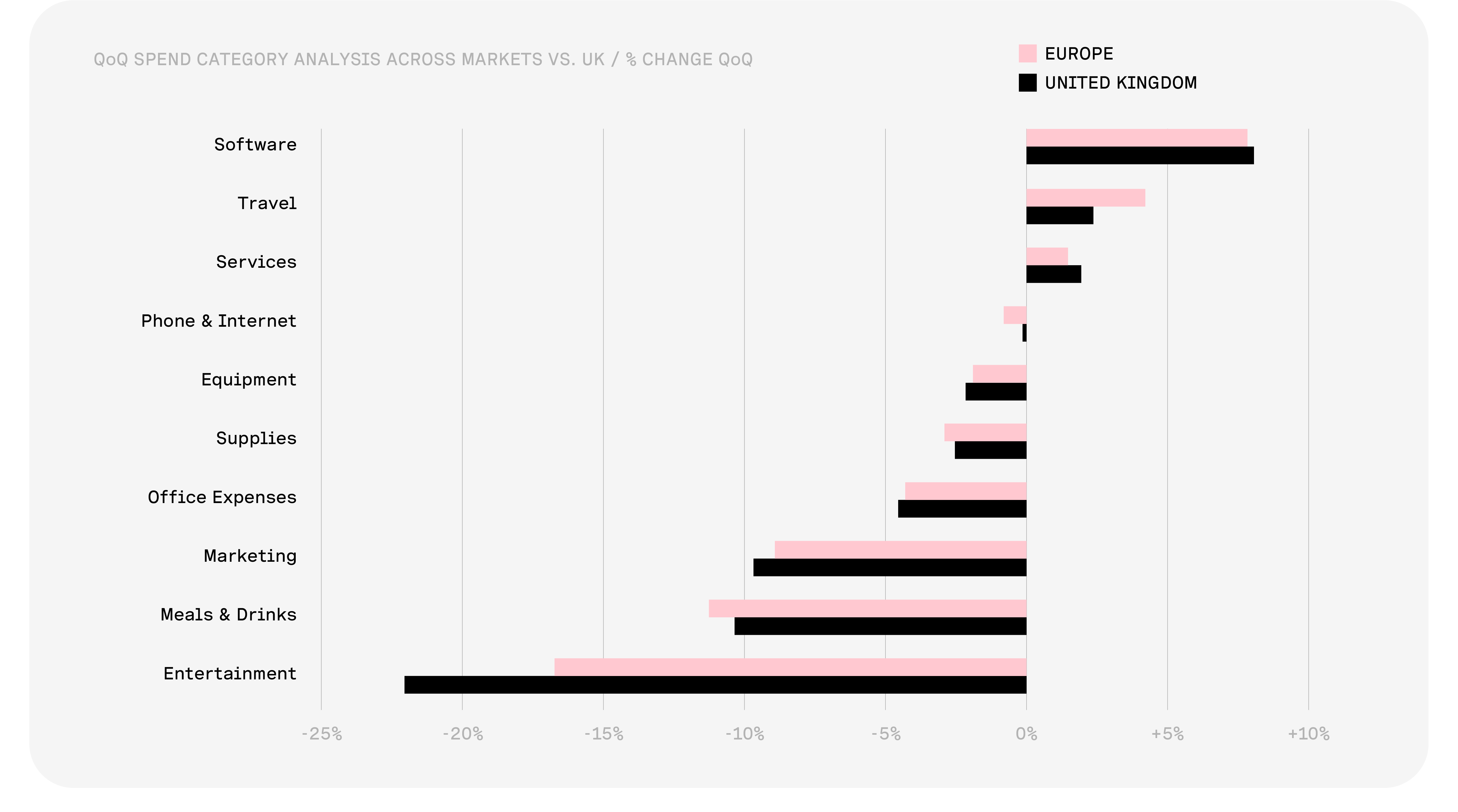
European Key Insights
- Biggest growth: Software rose 7.8% — the largest relative increase across all categories. Travel followed at +4.2%.
- Biggest decline: Entertainment fell 16.7%, most likely reflecting reduced corporate events and social spending after the holiday season.
- Cost control: Marketing (-8.9%) and Meals & Drinks (-11.3%) both dropped sharply, pointing to tighter variable expense management at the start of the year.
- Stable ground: Phone & Internet and Services barely moved — fluctuations of less than 1.5% in both cases.
UK Key Insights
- Holiday peaks: Entertainment and Marketing spiked in October and November, then dropped sharply in January and February. Entertainment peaked in December 2025 before falling dramatically by -34.9% in January alone.
- Software's steady climb: Unlike other categories, software spend grew almost every month, specifically by +7.1% between October and March.
- Post-holiday travel bounce: Travel dipped in December but rebounded strongly with a +46.9% surge by March, as business operations returned to normal after the winter break.
- Operational consistency: Phone & Internet and Services showed very little variance throughout the quarter.
Overall top merchants for Q1: Digital transformation, AI integration, and business travel
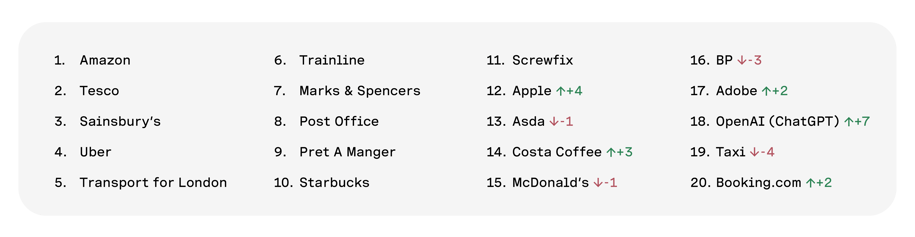 Based on the number of spending customers, card spend only, for Q1 2026.
One of the most significant data points in Q1 is OpenAI's appearance at #18. UK businesses are no longer experimenting with AI — they're paying for enterprise subscriptions and API usage at scale.
Alongside Adobe (#17) and Apple (#12), this confirms that a substantial share of corporate budgets now goes to the digital workstation and generative AI workflows.
Travel dominates the top 20, confirming that corporate mobility is at a new high in 2026. Trainline at #6 points to high-frequency domestic rail travel, likely a more practical and sustainable alternative to short-haul flights. Booking.com (#20) suggests investment in multi-night stays and team offsites. Uber (#4) and Taxi (#19) show that local mobility for client meetings remains a daily fixture for the UK workforce.
Amazon (#1) holds its position as the clear leader in UK business spend, accounting for 7% of total share of Q1 spend. Screwfix (#11) and BP (#16) signal sustained investment in infrastructure, facilities management, and fleet operations — a reminder that physical trade and logistics remain central to the UK economy.
High-street grocers punch above their weight on the business ledger. Tesco (#2) and Sainsbury's (#3) together account for 4% of total share of spend, likely a mix of staff perks and everyday supplies, particularly in smaller businesses.
And then there's the caffeine economy. Pret A Manger (#9), Starbucks (#10), and Costa Coffee (#14) all appear in the top 15. Some things don't change.
UK Core tech stack leaderboard
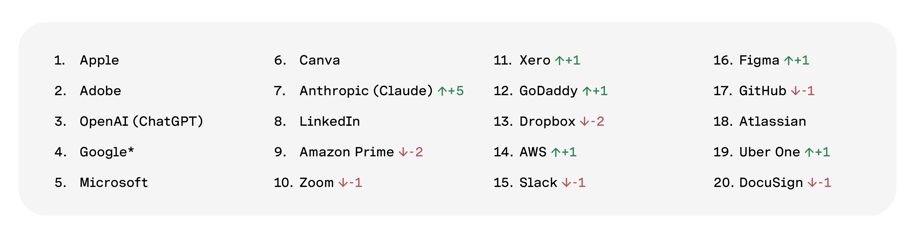 Based on the number of spending customers, card spend only, for Q1 2026.
* Can refer to Google Workspace, Google Cloud, Google One, or Google Play.
The biggest story in the UK software market is the massive shift toward Anthropic’s ecosystem.
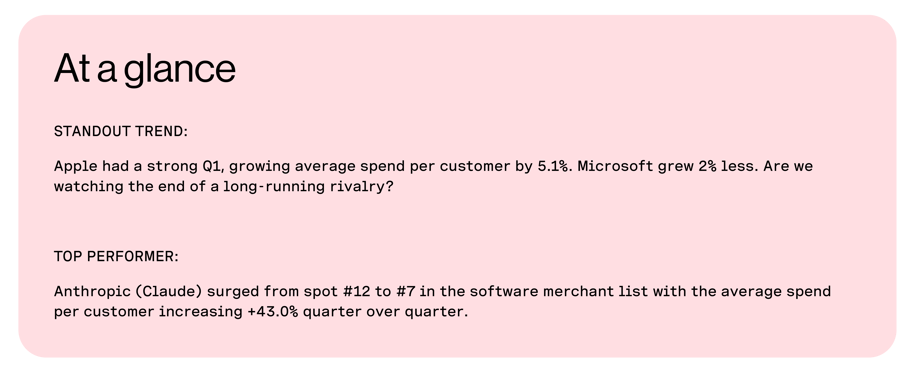
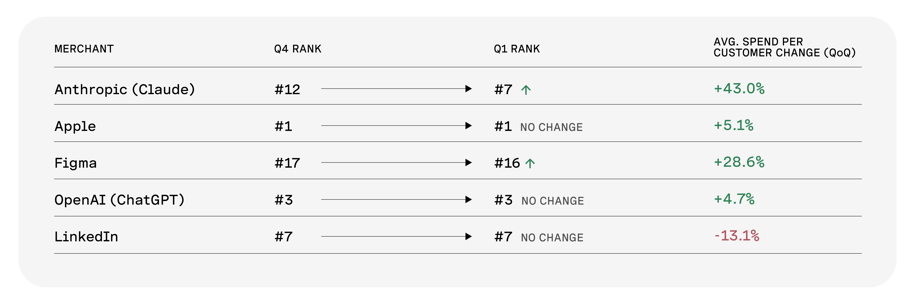
Anthropic (Claude) surged from #12 to #7, with the average spend per customer increasing +43.0%. That's a fast climb, and it signals that Anthropic has reached enterprise maturity in the UK market.
Another notable shift was Figma’s 28.6% jump in average spend with only a 5% increase in users. DocuSign barely hung on to its spot in the top 20. While Apple stayed steady, keeping its #1 spot.
The pattern is clear: UK businesses aren't just buying more software. They're buying more expensive software. The era of cheap SaaS is giving way to high-value AI and cloud infrastructure.
QoQ performance comparison for key software merchants
The CFO checklist: moving into Q2
Centralise and audit your AI and digital workstation stack
- Consolidate AI seats. With Anthropic (Claude) and OpenAI (ChatGPT) both in the top 20 for software, check for overlap. Many teams may be paying for both without using the distinct strengths of each.
- Check for stealth upgrades. Audit tools showing 25%+ spend increases — like Figma. Confirm teams are actually using the enterprise features they're paying for, rather than being auto-upgraded via per-seat AI add-ons.
Optimise travel and mobility budgets
- Rail-first policy. Trainline at #6 reflects a clear shift toward rail. A travel policy that incentivises rail over short-haul flights can reduce costs and improve your ESG position.
- Review local transport. Uber (#4) and Taxis (#19) are high-frequency costs. Corporate accounts or a Mobility as a Service platform can give you better visibility into last-mile travel spend.
That's the Q1 picture. AI adoption is accelerating, travel is back, and discretionary spend is under real pressure. We'll be back with updated data from Q2 — and no doubt a few more surprises.